Picture this: It’s a crisp autumn afternoon in my hometown, and I’m lacing up my sneakers for what I thought was a casual basketball pickup game. But when I arrived at the court, a group of enthusiastic players handed me a ball and explained we were playing netball instead. Confusion hit me like a missed free throw—I couldn’t dribble? No backboard for those satisfying bank shots? That day sparked my fascination with how two sports that look so similar on the surface can feel worlds apart. If you’ve ever wondered about the nuances separating basketball from netball, you’re in the right place. This deep dive explores their histories, rules, and everything in between, helping you appreciate each game’s unique thrill.
The Origins: How Basketball and Netball Came to Be
Basketball and netball share a family tree, but they’ve grown into distinct branches over time. Both trace back to the late 19th century, born from a need for indoor activities during harsh winters. Yet, their paths diverged early, shaped by cultural norms and rule tweaks that turned one into a global powerhouse and the other into a beloved team-focused gem.
Birth of Basketball
Dr. James Naismith, a Canadian physical education instructor, invented basketball in 1891 in Springfield, Massachusetts, using peach baskets as goals. He aimed to create a non-contact game to keep his students active indoors. From those humble beginnings, it exploded into the NBA spectacles we know today, with high-flying dunks and buzzer-beaters captivating millions.
Evolution into Netball
Just a year later, in 1892, netball emerged as a modified version for women, introduced by American teacher Clara Baer who misinterpreted basketball’s rules. Played first in England by 1895, it emphasized passing over physicality to suit societal views on women’s sports. Over decades, it standardized into the fast-paced, strategic game popular in Commonwealth countries.
Court Layout and Dimensions
At first glance, both courts are rectangular with hoops at each end, but dig deeper, and the differences shape gameplay profoundly. Basketball courts allow for fluid movement, while netball’s zoned design forces strategic positioning. This setup influences everything from player roles to defensive tactics.
Basketball courts measure 28 meters long by 15 meters wide for international play, with a free-throw line at 4.6 meters from the basket. Netball courts are slightly larger at 30.5 meters long by 15.25 meters wide, divided into three equal thirds with transverse lines. No three-point line in netball—scoring happens only from within the goal circle.
Here’s a quick comparison table:
| Aspect | Basketball | Netball |
|---|---|---|
| Length | 28 meters | 30.5 meters |
| Width | 15 meters | 15.25 meters |
| Divisions | Halves with key areas | Three thirds |
| Hoop Height | 3.05 meters | 3.05 meters |
| Backboard | Yes | No |
These variations mean basketball feels more open, like a canvas for individual flair, while netball is a puzzle demanding precise teamwork.
Number of Players and Positions
Team size sets the tone—basketball’s five-on-five allows for star-driven plays, whereas netball’s seven players emphasize collective effort. I once joined a netball scrimmage and felt the pressure of staying in my zone; it was humbling, like being part of a well-oiled machine rather than a solo act.
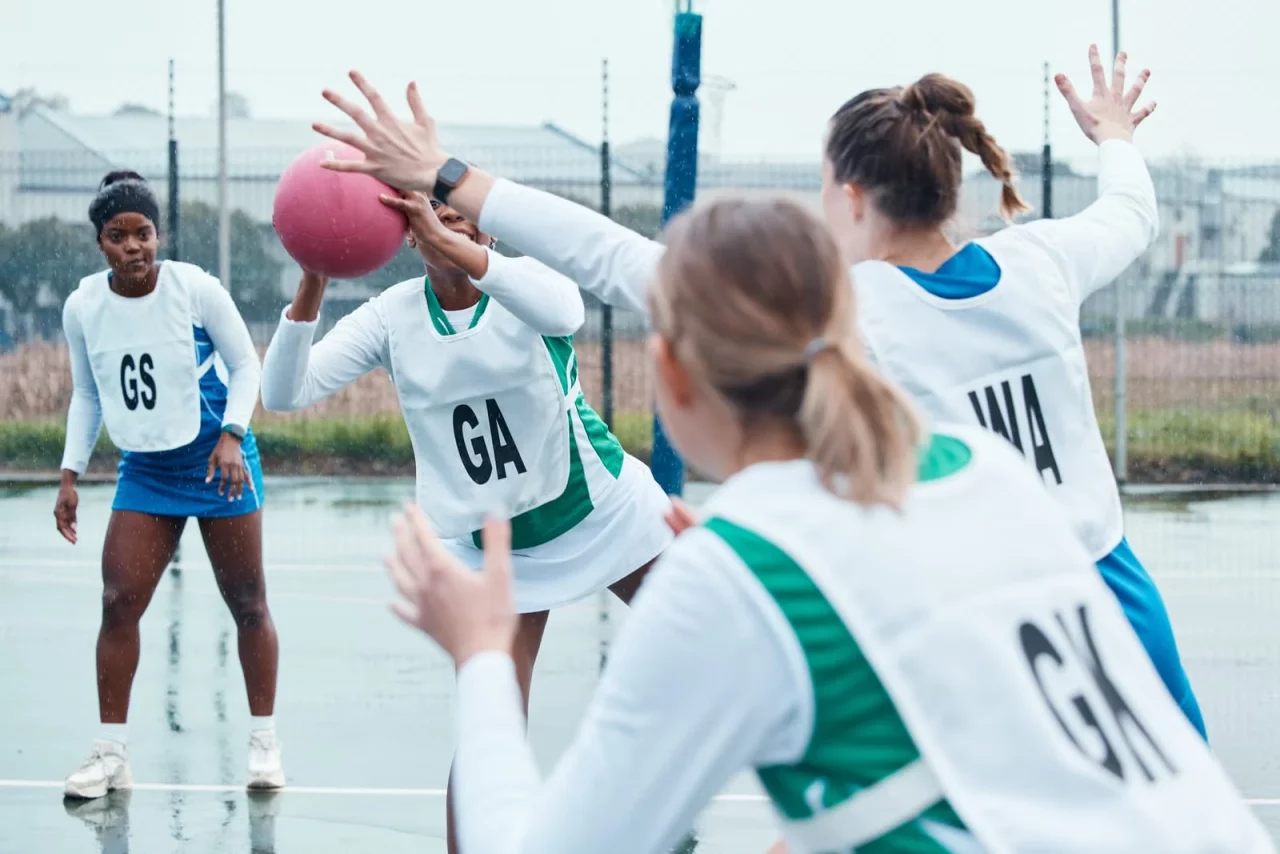
Basketball features fluid positions: point guard, shooting guard, small forward, power forward, and center, all roaming freely. Netball assigns strict roles like Goal Shooter (GS), Goal Attack (GA), Wing Attack (WA), Centre (C), Wing Defence (WD), Goal Defence (GD), and Goal Keeper (GK), each confined to specific court thirds. This zoning adds a layer of strategy that’s oddly satisfying.
- Basketball Positions Pros: Versatility lets players showcase multiple skills.
- Basketball Positions Cons: Can lead to ball-hogging if teamwork falters.
- Netball Positions Pros: Builds deep specialization and reliance on teammates.
- Netball Positions Cons: Less freedom might frustrate adaptable athletes.
In comparison, basketball’s setup rewards all-around athletes, while netball fosters niche experts, making each game a different kind of chess match on hardwood.
Rules of Play: Dribbling, Passing, and Movement
Here’s where the games truly split—basketball’s dribbling freedom versus netball’s pass-only mandate. Remember my first netball attempt? I instinctively bounced the ball and got whistled; it was a funny wake-up call to the sport’s elegant restraint.
Basketball permits unlimited dribbles and running with the ball, encouraging drives to the hoop. Netball bans dribbling entirely; players must pass within three seconds while pivoting on one foot. This rule amps up the pace, turning every possession into a rapid relay.
Key differences include:
- Basketball: Traveling if you take more than two steps without dribbling.
- Netball: Stepping foul for moving the landing foot while holding the ball.
- Both: Emphasize quick decisions, but netball’s no-run rule heightens tension.
Humorously, netball feels like basketball’s polite cousin—no slamming into opponents, just clever footwork and sharp passes that keep you on your toes.
Scoring Systems and Goals
Scoring might seem straightforward—throw ball in hoop—but the mechanics differ wildly. In basketball, that swish with a backboard assist feels triumphant; netball’s ring-only shots demand pinpoint accuracy, evoking a mix of pride and frustration when you nail it.
Basketball awards 1, 2, or 3 points per shot, with dunks and long-range threes adding flair. Netball keeps it simple: every goal from the semicircle scores 1 point, no bonuses for distance. Only GS and GA can shoot in netball, unlike basketball’s anyone-anywhere approach.
Pros of Basketball Scoring: Variety keeps games exciting with comebacks.
Cons: Can favor taller players for close shots.
Pros of Netball Scoring: Equalizes opportunities, rewarding precision.
Cons: Lacks the drama of a game-changing three-pointer.
This simplicity in netball builds emotional highs through sustained rallies, while basketball’s system fuels adrenaline rushes.
Physical Contact and Fouls
Contact levels define the intensity—basketball’s controlled physicality versus netball’s strict non-contact ethos. I’ve bumped shoulders in basketball pickup games, but netball’s distance rule made me feel like a dancer avoiding partners, adding a graceful challenge.
Basketball allows blocking and screening with fouls for excess. Netball prohibits contact; defenders must stay 0.9 meters away, penalized for obstruction. This reduces injury risk but demands mental sharpness.
- Basketball Contact Pros: Builds toughness and strategic physical play.
- Basketball Contact Cons: Higher injury potential from collisions.
- Netball Contact Pros: Safer for all ages, focuses on skill over strength.
- Netball Contact Cons: Frustrating for those who thrive on intensity.
Ultimately, basketball suits contact lovers, while netball appeals to tacticians, each offering unique emotional rewards.
Game Duration and Structure
Time flies differently in these sports—basketball’s quarters build suspense, netball’s shorter bursts keep energy high. During a netball quarter, the constant action left me breathless, a stark contrast to basketball’s timeouts that let you catch your wind.
Basketball games last 48 minutes (NBA) in four 12-minute quarters, with halftimes. Netball runs 60 minutes in four 15-minute quarters, no clock stops for minor issues. Substitutions vary: unlimited in basketball, limited in netball.
Comparison: Basketball’s structure allows dramatic shifts; netball’s flow maintains momentum, like a sprint versus a marathon with breaks.
Equipment Differences
Gear might seem minor, but it impacts feel and strategy. Basketball’s pebbled ball grips for dribbles; netball’s smoother one suits passing. I chuckled when I first held a netball—it felt lighter, almost inviting a gentle toss over a slam.
Basketball uses a larger, heavier ball (circumference 75-78 cm) with channels. Netball’s ball is smaller (69-71 cm) and lighter, no backboard on goals. Uniforms: Basketball jerseys are loose; netball often features bibs with positions.
| Equipment | Basketball | Netball |
|---|---|---|
| Ball Size | Larger, pebbled | Smaller, smoother |
| Goal Setup | With backboard | Ring only |
| Uniforms | Jerseys, shorts | Dresses/bibs |
These tweaks make netball more accessible for beginners, while basketball demands grip strength.
Popularity and Cultural Impact
Basketball reigns globally, thanks to icons like Michael Jordan, while netball thrives in places like Australia and England. Growing up, basketball was my gateway to team spirit; discovering netball later felt like uncovering a hidden gem that empowered women in sports.
Basketball boasts massive viewership, with the NBA drawing billions. Netball is female-dominated, with World Cups highlighting inclusivity. Culturally, basketball symbolizes urban grit; netball promotes community and strategy.
Health Benefits and Skills Developed
Both boost fitness, but their demands vary. Basketball hones explosiveness; netball sharpens agility. Playing both in my 20s, I felt basketball built my stamina, while netball improved my quick thinking—each leaving me sore but satisfied.
Basketball enhances aerobic endurance and strength. Netball focuses on footwork and coordination. Mental perks: Both reduce stress, but netball’s teamwork fosters deeper bonds.
Pros of Basketball: Explosive power, calorie burn.
Cons: Higher joint strain.
Pros of Netball: Better for agility, lower impact.
Cons: Less cardio variety.
Where to Get Started: Learning Basketball or Netball
Ready to jump in? Local community centers offer beginner classes for both. For basketball, check YMCA programs or apps like Meetup for pickup games. Netball leagues thrive in clubs; sites like Netball America provide resources. Best tools: Affordable balls from brands like Spalding for basketball or Mitre for netball—start practicing today!
People Also Ask
Based on common searches, here are real questions people ask about basketball and netball differences:
- How do the rules of netball differ from basketball? Unlike basketball, netball bans dribbling and requires passing within three seconds.
- Is netball the same as basketball? No, netball restricts positions and movement, emphasizing teamwork over individual plays.
- Why don’t netball players use basketball moves? Rules differ—netball’s no-dribble policy makes basketball tactics like layups illegal.
- What was invented first, basketball or netball? Basketball came first in 1891, with netball evolving shortly after.
FAQ
Can you play netball if you’re good at basketball?
Absolutely, but expect adjustments—no dribbling means relying on passes. Skills like shooting transfer well, but zoning takes practice.
Which sport is better for beginners?
Netball’s simpler rules and non-contact nature make it friendlier for newbies, though basketball’s popularity offers more resources.
Are the balls interchangeable between sports?
Not ideally—basketball balls are larger and grippier for dribbling, while netball ones are lighter for passing accuracy.
How does gender play a role in these sports?
Basketball is mixed but male-dominated professionally; netball is predominantly female but growing inclusively.
What’s the best way to switch from one to the other?
Start with drills: Practice netball’s pivots if from basketball, or add dribbling if vice versa. Join mixed clinics for fun transitions.
In wrapping up, whether you lean toward basketball’s high-energy flair or netball’s tactical grace, both sports offer joy, fitness, and camaraderie. That mix-up on the court years ago? It turned me into a fan of both, proving differences make the world—and sports—more exciting. Dive in, and you might find your new favorite.