Hey there, fellow water enthusiast! Imagine this: It’s a crisp summer morning in 1922, and a young guy named Ralph Samuelson is staring out at Lake Pepin in Minnesota, dreaming up ways to mimic his snow skiing adventures on water. Little did he know, that spark of curiosity would ignite two of the most exhilarating water sports we love today—water skiing and wakeboarding. I’ve spent countless hours on the lake myself, feeling the rush of the tow rope pulling me up, and let me tell you, understanding their roots makes every splash even more special. In this deep dive, we’ll trace their journeys from humble beginnings to global phenomena, blending history with tips to get you started. Buckle up—or should I say, strap in—for a ride through time.
The Dawn of Water Skiing
Water skiing burst onto the scene in the early 20th century as a playful experiment that quickly captured hearts. Born from the ingenuity of Ralph Samuelson, it started as a backyard project using simple pine boards and a clothesline rope. Samuelson, just 18, tested his contraption behind a modest outboard boat, proving that gliding over water could be as thrilling as slicing through snow. This innovation didn’t just create a sport; it laid the foundation for a family-friendly activity that would spread worldwide, drawing in millions who crave that perfect blend of speed and serenity on the waves.
From those early days, water skiing evolved rapidly. By the 1930s, exhibition shows were wowing crowds on both sides of the Atlantic, turning what was once a novelty into a competitive pursuit. The American Water Ski Association’s formation in 1939 marked a turning point, organizing the first national championships and standardizing rules. Today, it’s a staple at lakes and resorts, with variants like slalom and jumping keeping it fresh for all ages.
Ralph Samuelson’s Inventive Spark
Ralph Samuelson wasn’t your typical inventor—he was a daring teen with a love for adventure and access to Lake Pepin. After failing with snow skis and barrel staves, he crafted 8-foot pine boards, steaming their tips in his mom’s wash boiler for that essential upward curve. On July 2, 1922, he finally popped up on the water, towed by his brother Ben at 20 mph. That moment, acknowledged by the American Water Ski Association in 1966 as the sport’s official birth, changed everything. Samuelson’s shows from Michigan to Florida popularized it, and he even pioneered jumping ramps in 1925. His story reminds me of my first wipeout—frustrating, but oh-so-rewarding once you nail it.
Samuelson’s legacy lives on through milestones like the first ski jump and slalom runs. Without patents or fanfare at the time, he selflessly shared his creation, inspiring generations. Fast forward, and his invention has led to over 11 million U.S. participants annually, proving one person’s bold idea can create endless summer joy.
Early Milestones and Global Spread
The 1940s and 1950s saw water skiing explode in popularity, fueled by post-WWII leisure booms and innovations like fiberglass skis. Cypress Gardens in Florida became the sport’s mecca, hosting shows that drew celebrities and everyday folks alike. The first World Water Ski Championships in 1949 in France solidified its international status, with events expanding to include tricks and barefoot skiing by the 1960s. I remember hearing stories from my uncle about those early tournaments—pure adrenaline, with jumps soaring over 200 feet.
By the 1970s, water skiing was Olympic exhibition material, debuting in Munich in 1972. Technological advances, like the Ski Nautique boat in 1949, made it more accessible. Globally, it thrived in Australia (1.3 million skiers) and Europe, with cable systems emerging in the 1960s for urban fun. These milestones transformed a regional pastime into a worldwide passion, blending competition with casual cruises.
The Birth of Wakeboarding
Wakeboarding emerged in the 1980s as a rebellious offshoot, blending water skiing’s tow mechanics with surfing’s flair and snowboarding’s tricks. San Diego surfer Tony Finn kickstarted it in 1985 with the “Skurfer,” a hybrid board that let riders carve wakes like waves. What began as surfers experimenting with ski ropes evolved into a standalone sport, attracting thrill-seekers who wanted more airtime and style. Finn’s promotion via ESPN events in the early 1990s turned heads, and suddenly, lakes buzzed with sideways stances and flips.
The sport’s roots trace to “skurfing” in Australia and New Zealand, where riders used surfboards behind boats. By the late 1980s, Herb O’Brien’s Hyperlite board in 1991 revolutionized it with compression-molded designs for better buoyancy. Wakeboarding’s appeal? It’s forgiving for beginners yet endlessly progressive, much like my transition from skiing to boarding—scary at first, but liberating once you catch that wake.
Key Innovators in Wakeboarding
Tony Finn, often called the “Father of Wakeboarding,” deserves the spotlight for his Skurfer, which bridged surfing and skiing. But credit also goes to Jimmy Redmon for design tweaks and Herb O’Brien for the game-changing Hyperlite, enabling deep-water starts for all. These pioneers, alongside early skurfers like Jeff Darby, pushed boundaries in the 1980s, hosting informal comps that built community. Their innovations, from foot straps to neutral-buoyancy boards, made wakeboarding accessible and explosive.
In the 1990s, figures like Shaun Murray and Parks Bonifay elevated it to pro status, with Murray’s fluid style and Bonifay’s record jumps inspiring the next wave. Today, athletes like Tom Fooshee continue this legacy, but it’s the innovators’ grit—testing prototypes on choppy waters—that turned a fringe idea into the fastest-growing water sport, boasting nearly 4 million global participants yearly.
Evolution and Overlaps Between the Sports
Wakeboarding didn’t spring from nowhere; it evolved directly from water skiing’s monoski era in the 1950s, where riders stood sideways on single boards. By the 1980s, surfers towed behind boats created “skurfing,” merging with skiing’s techniques for tricks over wakes. This overlap is evident in shared equipment like tow ropes, but wakeboarding flipped the script—embracing the wake instead of avoiding it. I’ve seen hybrids like wakeskating bridge them further, but the evolution highlights how skiing’s stability paved the way for boarding’s creativity.
Milestones like the 1992 World Wakeboard Association formation mirrored skiing’s 1939 AWSA debut, fostering competitions. Today, USA Water Ski & Wake Sports governs both, with events blending disciplines. This shared heritage means skills transfer—skiers often pick up wakeboarding faster, adding aerial flair to their arsenal. It’s a beautiful progression, turning lakes into playgrounds for innovation.
What is Water Skiing?
Water skiing is a surface water sport where you’re towed behind a boat on one or two skis, skimming the surface at speeds from 15-36 mph. It demands balance, core strength, and endurance, with variants like slalom (one ski, zigzagging buoys), tricks (spins and flips), and jumping (ramping for distance). Perfect for calm waters, it’s about speed and precision, facing forward for that straight-line thrill. As a lifelong skier, I can attest—nothing beats the glide of fresh glass on a combo set.
Whether recreational or competitive, it builds full-body fitness while offering scenic cruises. Equipment includes skis (wood, aluminum, or fiberglass), a tow rope, and a life jacket. It’s inclusive, with adaptive versions for all abilities, making it a gateway to towed sports.
What is Wakeboarding?
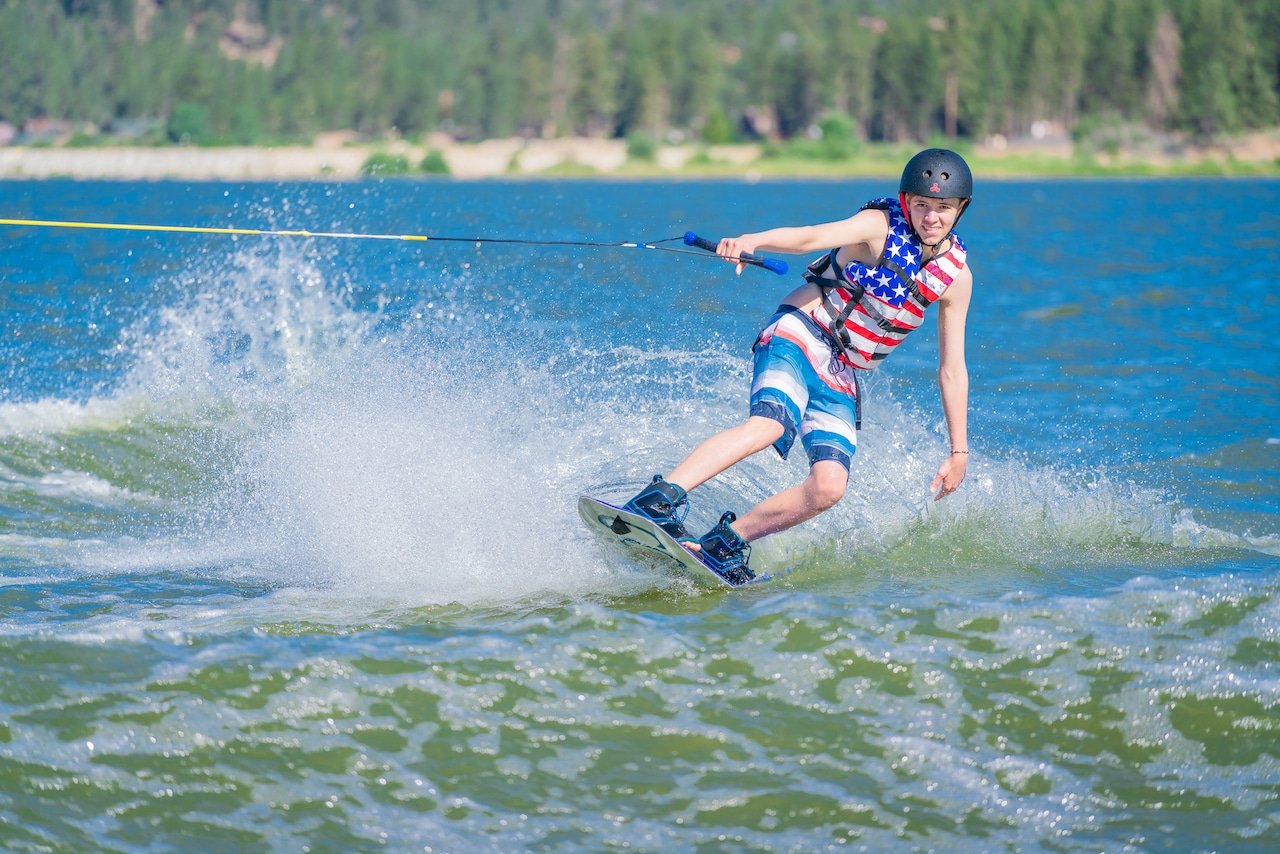
Wakeboarding involves riding a single board with bindings, towed at 15-25 mph behind a boat, using the wake for jumps and tricks. Riders stand sideways, like snowboarding, performing inverts, spins, and grabs. It’s dynamic, emphasizing aerial maneuvers over flat water, with boards featuring rockers for pop. My first wakeboard session felt chaotic—arms flailing—but mastering that edge control? Pure magic.
From freestyle behind boats to cable parks, it’s versatile and social. Gear includes wakeboards (concave bottoms for lift), low-stretch ropes, and helmets. As the world’s fastest-growing water sport, it appeals to trick lovers, blending surfing’s flow with skiing’s pull.
Where to Learn Water Skiing and Wakeboarding
Diving in? Start at dedicated schools like McKenzie Water Ski School in California for personalized lessons, or High Sierra on Lake Tahoe for scenic sessions. For wakeboarding, try Ski Rixen in Florida’s cable system—affordable and beginner-friendly. Camps like Coble Water Ski and Wakeboard in North Carolina offer immersive experiences for all ages. Locally, check USA Water Ski & Wake Sports affiliates for clinics.
Pro tip: Book private lessons first; instructors like those at Birkholm’s in Tahoe make deep-water starts a breeze. Whether lakeside or resort-based, these spots provide gear and safety focus, turning novices into confident riders.
Best Tools and Gear for Beginners
Gear up right to avoid frustration—here’s what shines for newbies in 2025. For water skiing, the Radar Union skis offer wide tips for easy ups, paired with Vector boots for comfort. Combo sets like O’Brien Celebrity are stable and forgiving. For wakeboarding, Ronix Krush boards provide hybrid rockers for smooth rides, bundled with Divide bindings.
Don’t forget ropes: Radar Control for skiing’s stretch, or low-stretch for boarding. Life jackets from Stohlquist are essential. Budget packages under $300 make entry easy—check WakeMAKERS or Wakesports Unlimited for deals.
| Gear Type | Best for Beginners (Water Skiing) | Best for Beginners (Wakeboarding) | Price Range (2025) |
|---|---|---|---|
| Skis/Board | Radar Union Combo | Ronix Krush | $200-400 |
| Bindings/Boots | Vector Boots | Divide Bindings | $100-250 |
| Rope | Radar Control (75 ft) | Hyperlite Low-Stretch | $50-100 |
| Life Jacket | Stohlquist Edge | O’Neill Reactor | $80-150 |
These picks balance affordability and performance, helping you focus on fun.
Comparison: Water Skiing vs. Wakeboarding
Both sports tow you across water, building balance and strength, but their vibes differ wildly. Water skiing emphasizes speed and endurance on flat water, ideal for groups with tandem rides. Wakeboarding thrives on wakes for tricks, solo-focused with endless progression. Speeds overlap (15-30 mph), but skiing hits higher for slalom.
Similarities include core workouts and boat dependency, but skiing’s forward stance feels intuitive for runners, while boarding’s sideways mimics snow sports. Injuries? Skiing strains legs more; boarding risks shoulders from falls. I’ve switched between them—skiing for relaxed days, boarding for adrenaline.
Pros and Cons Lists
Water Skiing Pros:
- Easier for absolute beginners due to two-skis stability.
- Great group activity—multiple riders possible.
- Builds endurance and speed skills quickly.
- Lower injury risk on flat water.
Water Skiing Cons:
- Requires more space and smoother conditions.
- Gear readjustment after falls is tedious.
- Less trick variety without advanced setups.
- Higher speeds can intimidate newbies.
Wakeboarding Pros:
- Explosive tricks and jumps keep it exciting.
- Single board simplifies recovery from falls.
- Versatile for parks or boats; creative freedom.
- Forgiving rocker designs for learning curves.
Wakeboarding Cons:
- Sideways stance steeper learning curve.
- Wake dependency means choppy days challenge.
- Higher fall impact from airs.
- Solo nature limits group play.
Famous Pioneers and Athletes
Water skiing’s icons include Ralph Samuelson, the inventor, and Dick Pope Sr., Cypress Gardens founder who popularized shows. Modern stars like Will Asher dominate slalom with record passes. For wakeboarding, Tony Finn sparked it, while Parks Bonifay’s flips and Shaun Murray’s style set standards. Current pros like Tom Scherer blend both sports seamlessly.
These athletes, from Bonifay’s X Games golds to Asher’s world titles, inspire with grit. Fun fact: Even celebs like Barack Obama have dabbled, but it’s the pros’ dedication that elevates the sports.
People Also Ask (PAA)
Who Invented Water Skiing?
Ralph Samuelson invented water skiing in 1922 on Lake Pepin, Minnesota, using pine boards as skis. After trial and error, he succeeded on July 2, becoming the first recorded skier. Officially recognized in 1966, his innovation spread globally.
When Did Wakeboarding Start?
Wakeboarding started in the 1980s with “skurfing,” but Tony Finn’s 1985 Skurfer marked its formal birth. By 1991, Herb O’Brien’s Hyperlite board propelled it forward, leading to pro tours in the 1990s.
Is Water Skiing Harder Than Wakeboarding?
For beginners, water skiing is often easier due to forward stance and stability, but wakeboarding’s tricks add complexity. It depends on background—snowboarders may prefer boarding. Both build similar skills, but skiing demands more endurance.
What Are the Benefits of These Sports?
Both boost cardio, strength, and balance while reducing stress. Water skiing enhances leg power; wakeboarding improves agility. They’re social, accessible, and promote outdoor fun, with low barriers for entry-level participation.
FAQ
How Do I Get Started with Water Skiing as a Beginner?
Start with lessons at a school like DFW Water Ski—focus on deep-water starts. Use combo skis for stability, wear a life jacket, and practice in calm water. Build core strength off-water with planks. Patience is key; most get up in one session.
What’s the Best Wakeboard for a First-Timer?
The Ronix Vault 2.0 is ideal—forgiving rocker, lightweight, and versatile for growth. Pair with soft bindings. Aim for 2025 models under 5’6″ for adults up to 180 lbs. Rent first to test fit.
Can Kids Learn Both Sports Safely?
Absolutely, with proper gear and supervision. Schools like Coble Camp cater to ages 5+, starting slow at 13-15 mph. Helmets and vests are musts; adaptive programs ensure fun for all.
How Has Technology Changed These Sports?
From fiberglass skis to ballast systems in boats, tech has made starts easier and wakes customizable. Cable parks reduce boat needs, while apps track progress—making both more inclusive and thrilling.
There you have it—a splashy journey through water skiing and wakeboarding’s history. Whether you’re channeling Samuelson’s daring or Finn’s creativity, these sports promise endless waves of excitement. Grab your gear, hit the lake, and create your own milestones. What’s your first story going to be? Safe rides!